The Solar System
Stars
Galaxies, Nebulae Other Structures
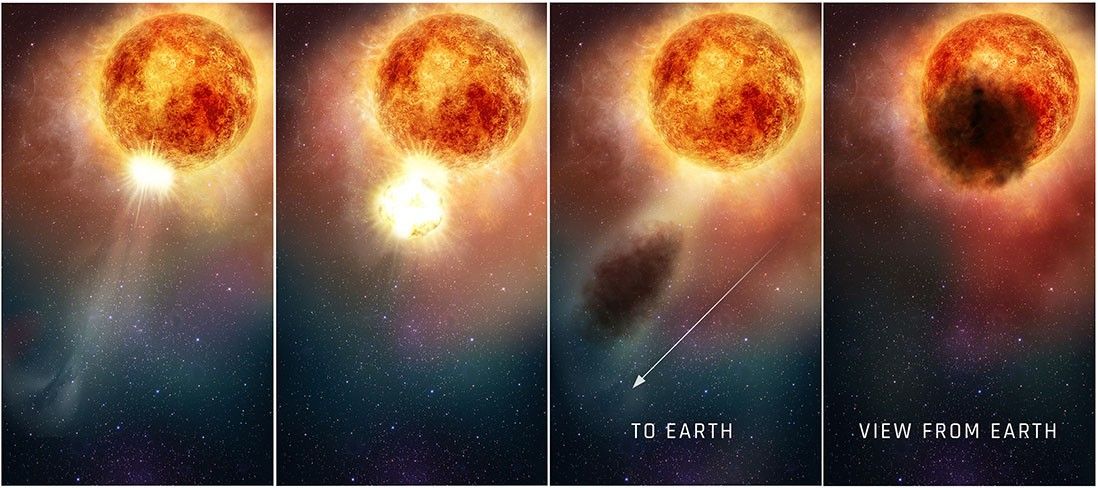
AU is the distance between the Earth and the Sun. One AU is 92,955,807.3 miles or 149,597,870.7 kilometers. It takes light 8 minutes and 20 seconds to travel one AU. This means that when you look outside, you are looking at light 8 minutes and 20 seconds ago. Basically, you are seeing old light. For example, lets say the star Betelgeuse just exploded. It would take us about 700 years for us to see it explode because it is about 700 light years away.
Light seconds, minutes, hours, and years are all based on the distance LIGHT can travel in that time period. So a light year is 5,878,625,373,183.6 mi. (~6 trillion)* or 9,460,730,472,580.8 km. (~10 trillion)*. These numbers represent how far light can travel in a year.
A light second is 186,282 mi* or 299,792 km*.
A light minute is 11,176,943 mi* or 17,987,547 km*.
And finally, a light hour is 670,616,629 mi* or 1,079,252,848 km*.
The final set of measurements are parsecs, kilo parsecs, and mega parsecs.
A parsec is 3.26 light years or 19,170,000,000,000 mi.
A kilo parsec is 3261.56 light years or 19,170,000,000,000,000 mi.
And last, but DEFINITELY NOT least (seriously though), one megaparsec is 3,261,563.77697573 light years or 19,170,000,000,000,000,000 mi.
WAIT!!! There is one more thing! Here is the order of the planets: Mercury, Venus, Earth, Mars, Jupiter, Saturn, Uranus, and Neptune.
*Note: All measurements that deal with light movement are accurate for light in a perfect vacuum. In other substances, light moves just slightly slower.
Our Solar System is one of the many star systems in the Universe, but the only one with known life. Most star systems are binary (two stars orbiting each other) or have more. We (obviously) have only one star, the Sun. Star systems are formed over million of years. A dense cloud of hydrogen and dust collapse and swirl over a forming star. The leftover dust and gas creates an accretion disc (disc of dust and gas, black holes have these), which is the starting the formation of the planets. After ~50-100 million years, the star system is fully formed.

Right now, our solar system is about 4.6 BILLION years old.
The Sun's mass is equal to about 330,000 Earths.
960,000 Earths can fit in the Sun, but because Earth is a semi-perfect sphere, space will be left over.
The Sun takes up 99.8% of all mass in the Solar System!
Mercury is the closest to the Sun and has no atmosphere. Contrary to popular belief, Mercury is NOT the hottest planet in our Solar System.
The hottest planet in the Solar System is Venus due to its thick atmosphere which traps heat within the planet. Plus, the volcanic activity on Venus adds to the heat. Venus is ~460 degrees Celsius.
All gas giants (Jupiter, Saturn, Uranus, and Neptune) have rings. Saturn just has the biggest and therefore, the most popular ones.
Some scientists and astronomers (and other space fields) say that if Jupiter was just ~13 times its mass to become a brown dwarf, and ~80 times its mass to become a true star.
Mars used to have rivers and lakes, but over time Mars' atmosphere grew thin and the planet cooled, leaving only valleys, river paths, and polar ice caps.
The Martian dirt is so old that it is rusting (iron oxide)! This gives Mars its red color.
Saturn is less dense than water. This means that Saturn would float like a boat if we put it in a Saturn-sized pool.
Uranus rotates on its side at a 98° tilt.
Neptune has the fastest winds in the Solar System that can go up to ~1,300 mph (~2,100 km/h).
Stars are formed from clouds of gas and dust called nebulae. Gravity causes the gas and dust to collapse and form a protostar. As the protostar continues to collapse, it heats up until nuclear fusion begins in its core, marking the birth of a star.
A star is a giant nuclear fusion power plant. A star's core is so hot and dense it cause hydrogen atoms to fuse together to create heavier and heavier atoms. This will add on and on until it creates an atom that is too heavy for the star. This causes stars to collapse under its own mass creating, depending on the size/type, either a black hole, neutron star, or a white dwarf.
Our sun is a Main Sequence star. This means when our Sun is at the end of its life, it will swell into a red giant, that it will consume Mercury, Venus, and maybe Earth and Mars, and then shed its outer layers to form a planetary nebula, leaving a White dwarf and the rest of the surviving planets (white dwarf will cool to a black dwarf in trillions of years). A White dwarf is the left over super-dense core of a Main Sequence star and a Red dwarf.
Red dwarfs are the most common and smallest star in the Milky Way. Red dwarfs live for trillions of years, so none have died yet. The reason why none have died is because the Universe is too young, only 13.8 billion years old.
Massive stars only live up to tens of millions of years due to their hydrogen consumption. Unlike the Sun, which doesn't fuse all the way to iron, massive stars do. Iron doesn't release energy from fusion. This causes the core to collapse and the outer layers explode into a supernova.* At the end, a neutron star or a black hole, depending on the mass of the star, is left over.
Very massive stars are the same as massive stars but the core is heavier, which results in a black hole(more about black holes and star remnants alike later).
Stars use mass-energy conversions, which is basically, E=mc2.
*Note: Some supernovae leave nothing behind . These are called failed supernovae. Experts think that when some massive stars run out of fuel, they just collapse into a black hole without exploding. Also, stars actually implode instead of explode because stars collapse under their own gravity, meaning the stars shrink (only for mere seconds) before they go boom-that is called imploding.
Galaxies are like star cities. Galaxies are gravitationally bound systems that consist of millions to trillions of stars, star systems (learned about this before), gas and dust, and dark matter (dark matter is invisible, scientists aren't 100% sure what dark matter or dark energy is, get more into it later). There is also a supermassive black hole (SMBH) in the center of most galaxies. Experts say that supermassive black holes are created differently. I will get into that later.
Galaxies come in many different types. These types are spiral galaxies, elliptical galaxies, irregular galaxies, lenticular galaxies, and dwarf galaxies.
Spiral galaxies are disk-shaped and have spiraled arms winding out from the center. Spirals contain both young stars and older stars. Examples of spirals are our very own, Milky Way Galaxy and our neighbor, the Andromeda Galaxy. Spirals have subtypes (Hubble classification):

Elliptical galaxies are oval-shaped and have little to no structure. They contain mostly older stars and very little gas and dust. Ellipticals have subtypes based on their shape:
Irregular galaxies have no defined shape or structure. They often result from gravitational interactions or collisions between galaxies. Irregulars contain a mix of young and old stars, as well as significant amounts of gas and dust. Examples of these are the Large and Small Magellanic Clouds, which orbit the Milky Way
Lenticular galaxies are lens-shaped and have a central bulge with a disk-like structure but lack prominent spiral arms. They contain older stars and have less gas and dust compared to spiral galaxies. Experts think that lenticular galaxies may have been a spiral galaxy in the past but lost their arms due to interactions with other galaxies. An example of this is NGC 5866, aka the Spindle Galaxy.
Dwarf galaxies are small galaxies that contain only a few billion stars, which is significantly fewer than the Milky Way's 100 billion stars. They can be elliptical, spiral, or irregular in shape and are often found in groups or clusters.
Nebulae are vast clouds of gas and dust in space. They can be the birthplaces of stars (like the Orion Nebula) or remnants of dead stars (like the Crab Nebula).
Galaxy clusters are groups of galaxies held together by gravity. They can contain hundreds to thousands of galaxies.
Superclusters are massive structures that consist of multiple galaxy clusters. They are among the largest known structures in the Universe.
There are four main types of nebulae: emission nebulae, reflection nebulae, planetary nebulae, and dark nebulae.
Emission nebulae are clouds of ionized gas that emit light of various colors. They are often associated with regions of active star formation. An example is the Orion Nebula.
Reflection nebulae do not emit their own light but instead reflect the light of nearby stars. They often appear blue because blue light is scattered more than other colors. An example is the Pleiades star cluster.
Planetary nebulae are shells of gas and dust ejected by dying stars. Despite the name, they have nothing to do with planets. An example is the Ring Nebula.
Dark nebulae are dense clouds of gas and dust that block the light from stars and other objects behind them. An example is the Horsehead Nebula.
Thank you for reading! I hope you learned something new about space. Space is an amazing place full of wonders and mysteries.
"Keep looking up." - Neil deGrasse Tyson
Image credits as noted. This site is not affiliated with or endorsed by anyone or anything.
Measurements and Distances in Space
Solar System
Stars
Galaxies, Nebulae, and Other Structures
The Mechanical Genius is a young boy who enjoys coding, astrophysics, building, and video games. He plays Battlefield 6, Helldivers 2, Kerbal Space Program, Diablo IV, Factorio, and more. This is his first website. Make sure to visit his YouTube channel linked below. He would love if you could like and subscribe. He lives in California.
The Mechanical Gamer Stop Motion Animation by TMGamer_
↑ Back to Top ↑ Back to Top